The 30-Minute Golf Fitness Program: Mobility, Stability and Speed
Three days a week, thirty minutes a session. The minimum effective dose of golf-specific fitness.

Golf is a rotational power sport disguised as a leisure activity. A small amount of targeted training beats hours of generic gym work for swing speed and consistency. The 30-minute program below is the minimum effective dose we prescribe at FairwayAuthority — built with TPI-certified trainers, field-tested by amateurs and competitive players, and designed for people who do not want to spend their evenings in a gym.
Training Principles
Train three qualities, in this order: mobility (joints can move through full range), stability (joints can resist unwanted movement), and speed (you can move fast when it matters). Skipping ahead — chasing speed before you have built the mobility and stability to express it — is the single most common reason amateurs hurt their backs trying to train for golf.
Three sessions per week of 30 minutes is the sweet spot. Less than that and adaptations are too slow to be motivating; more than that and most time-constrained adults stop showing up. Consistency beats intensity. A 30-minute session you complete 50 weeks a year will out-train a 90-minute session you complete 20 weeks a year, every time.
Warm up for two to three minutes before each session with light cardio — walking, a few air swings, or easy jump rope — to raise tissue temperature. Cold tissue tears; warm tissue stretches.
Mobility Block (10 minutes)
Mobility work targets the three joint complexes that allow a golfer to rotate: hips, thoracic spine, and lead-side ankle. Run each exercise for one minute, rest 30 seconds, and complete two rounds.
- 90/90 hip switches — 8 per side. Sit on the floor with both knees bent at 90°. Rotate from one side to the other, keeping your chest tall. Builds hip internal and external rotation, the single most important range of motion for a golf swing.
- Thoracic spine open-books — 8 per side. Side-lying with knees stacked, rotate the top arm overhead and across to the opposite side. Restores the separation between hips and shoulders that produces effortless coil.
- Half-kneeling adductor rocks — 8 per side. From a half-kneeling position with one leg extended to the side, rock your hips over the extended leg. Opens the lead hip for a fuller backswing and a cleaner finish.
If you can only do one mobility drill, do open-books. T-spine mobility is the limiting factor for almost every amateur over 35.
Stability Block (10 minutes)
Stability work teaches the body to resist unwanted movement — particularly anti-rotation through the core, which is what allows a golfer to coil hard without losing posture or balance.
- Pallof press — 10 per side, 2 sets. Stand sideways to a cable or resistance band, press the handle out from your sternum, and resist the band's pull to twist you. This is the king of anti-rotation exercises for golfers.
- Single-leg Romanian deadlift — 8 per side, 2 sets. Builds posterior-chain strength and the single-leg balance you need at impact and through follow-through.
- Side plank with reach — 30 seconds per side, 2 sets. Trains the lateral core, which stabilizes the spine during the rotational forces of a full swing.
If you train at home with no equipment, replace the Pallof press with a "dead-bug" hold for 30 seconds per side. It is not quite as effective, but it hits the same anti-rotation pattern.
Speed Block (10 minutes)
Speed work is the part most amateurs skip — and the part that pays the biggest performance dividend. Once mobility and stability are in place, you can safely train your body to move faster, and a faster body means a faster clubhead.
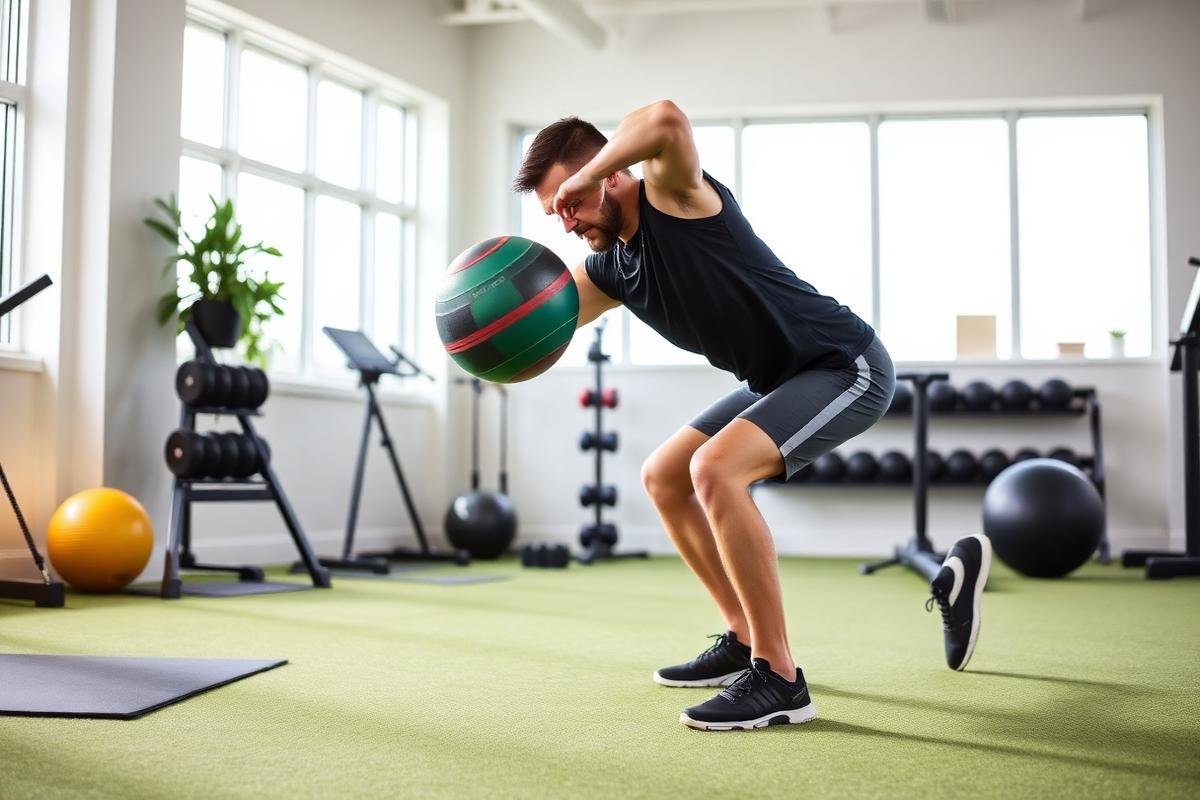
- Medicine ball rotational throw — 5 per side, 4 sets. Stand sideways to a wall, hold a 6–10 lb medicine ball at your trail hip, rotate explosively and throw the ball into the wall. Recover for 45 seconds between sets — these are sprints, not endurance work.
- Overspeed swings with light training club — 6 reps, 3 sets. Swing a 20% lighter training club (or alignment stick) as fast as possible — left-handed, right-handed, alternating. SuperSpeed-style protocols add 4–8 mph of clubhead speed for most amateurs over 6 weeks.
Always do speed work fresh — at the start of the session if you only care about speed, or after a thorough mobility block. Never train speed when fatigued; it teaches your nervous system to move fast with poor mechanics and increases injury risk.
Always consult a healthcare professional before starting any new exercise program, especially if you have a history of back or shoulder injury. For more programming and full video demonstrations, see our Fitness & Training hub and pair this routine with our swing fundamentals guide to make sure the speed you build expresses itself correctly at impact.
Frequently asked questions
How often should I do golf-specific training?
Three 30-minute sessions per week is the sweet spot for time-constrained amateurs.
Will lifting weights hurt my golf swing?
No — appropriately programmed resistance training improves swing speed and reduces injury risk. Avoid only maximal heavy lifting close to a round.
Key takeaways
- Mobility, then stability, then speed.
- Thirty minutes, three times a week beats long, occasional sessions.
- Rotational power is the trainable quality with the biggest swing-speed return.